Document & post

From Credit Risk to Climate Risk: CCPT Beyond Compliance

Captured 13 August 2026 · LinkedIn displayed “1yr •” at capture. Original publication date unverified.

Read the original LinkedIn post Jump to original text ↓
Risk & resilience

Original illustrated document

10 pages to explore

Download PDF (626 KB)
Page 1 of From Credit Risk to Climate Risk: CCPT Beyond Compliance. Read the extracted page text below or open the original PDF.

Page 1 of 10

Read the document text, page by page

Automatically extracted from the original PDF. Reading order and symbols may differ from the designed pages; the PDF remains the authoritative visual version.

Page 1

From Credit Risk to Climate Risk: Applying CCPT Beyond Compliance Six practical Malaysian Industries Scenarios Source : BNM CCPT Guidance

Page 2

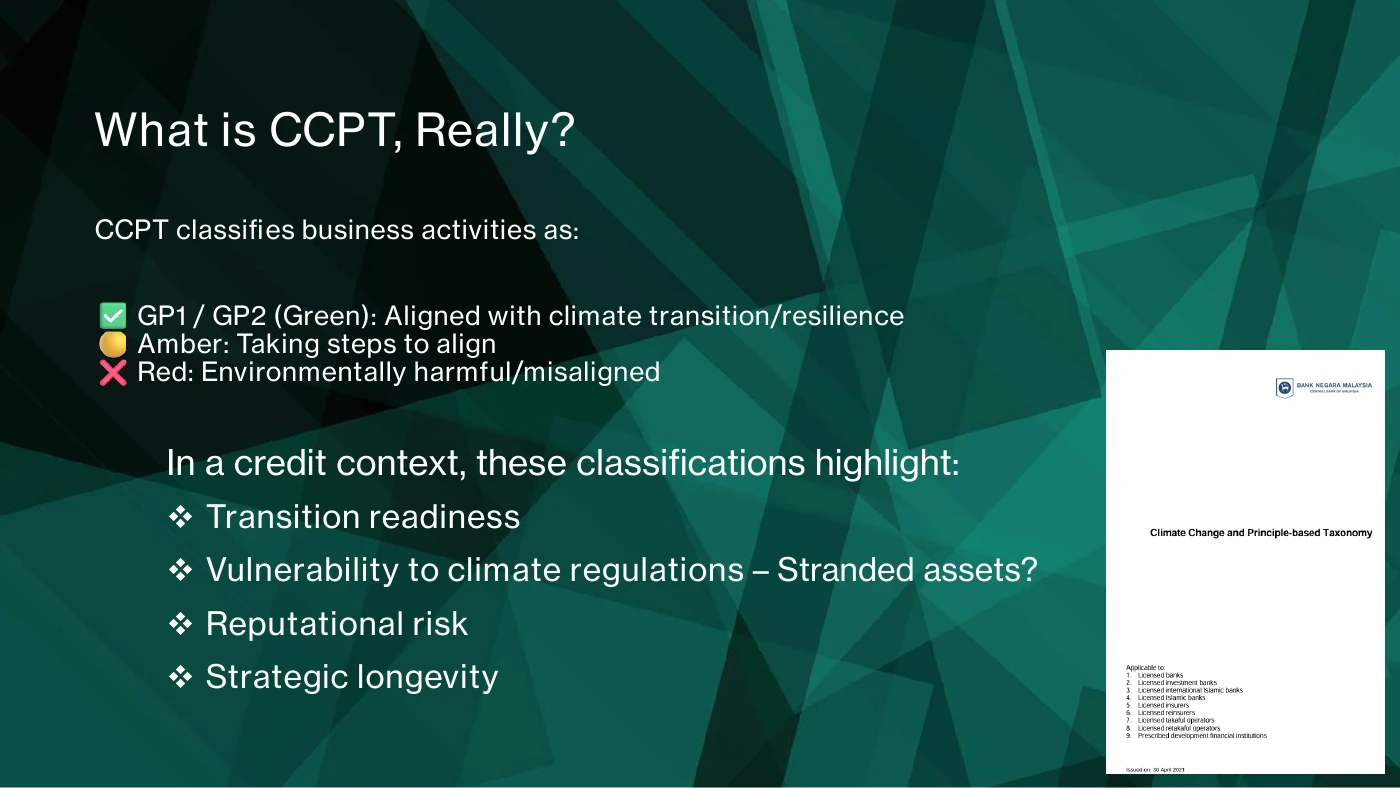
What is CCPT, Really? CCPT classifies business activities as: GP1 / GP2 (Green): Aligned with climate transition/resilience Amber: T aking steps to align Red: Environmentally harmful/misaligned In a credit context, these classifications highlight: ❖ Transition readiness ❖ Vulnerability to climate regulations – Stranded assets? ❖ Reputational risk ❖ Strategic longevity

Page 3

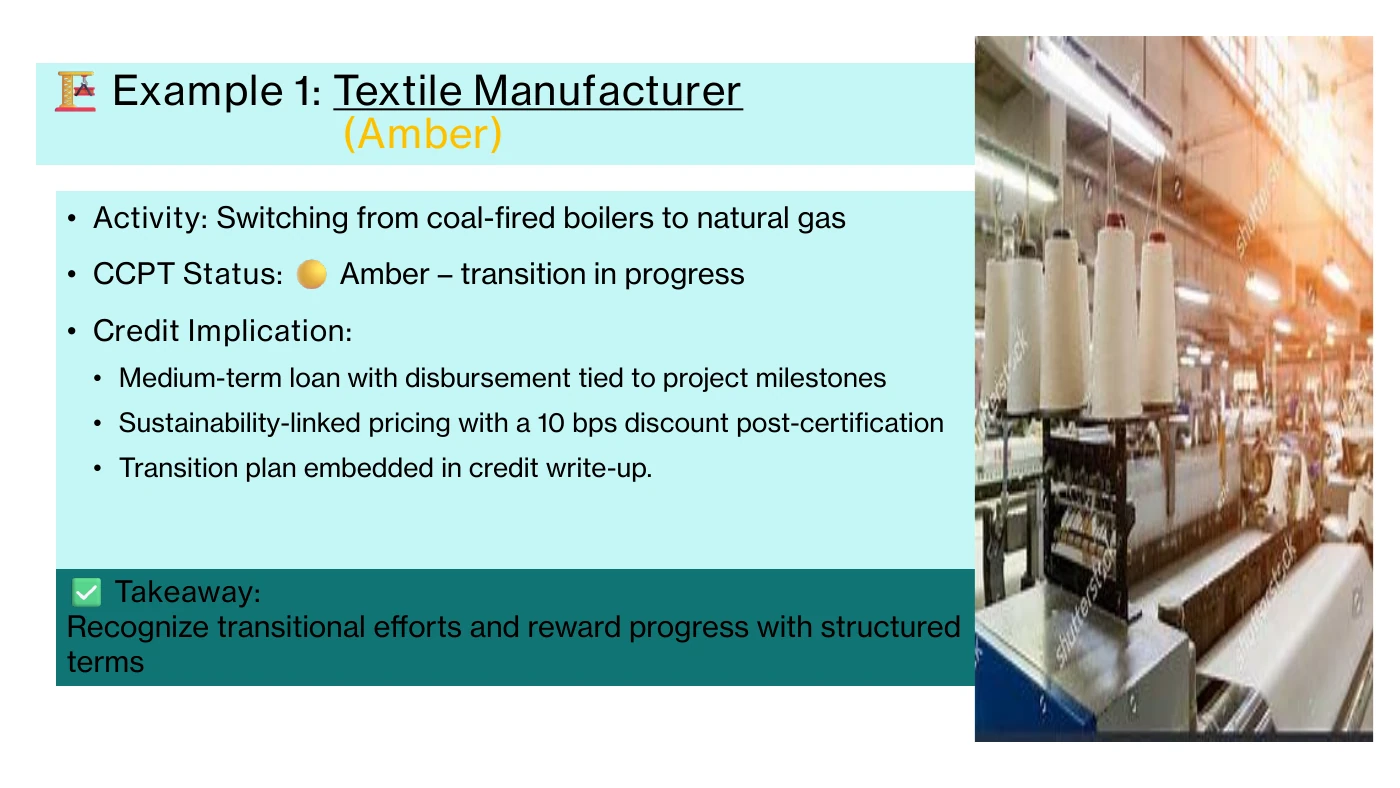
Example 1: T extile Manufacturer (Amber) • Activity: Switching from coal-fired boilers to natural gas • CCPT Status: Amber – transition in progress • Credit Implication: • Medium-term loan with disbursement tied to project milestones • Sustainability-linked pricing with a 10 bps discount post-certification • Transition plan embedded in credit write-up. T akeaway: Recognize transitional efforts and reward progress with structured terms

Page 4

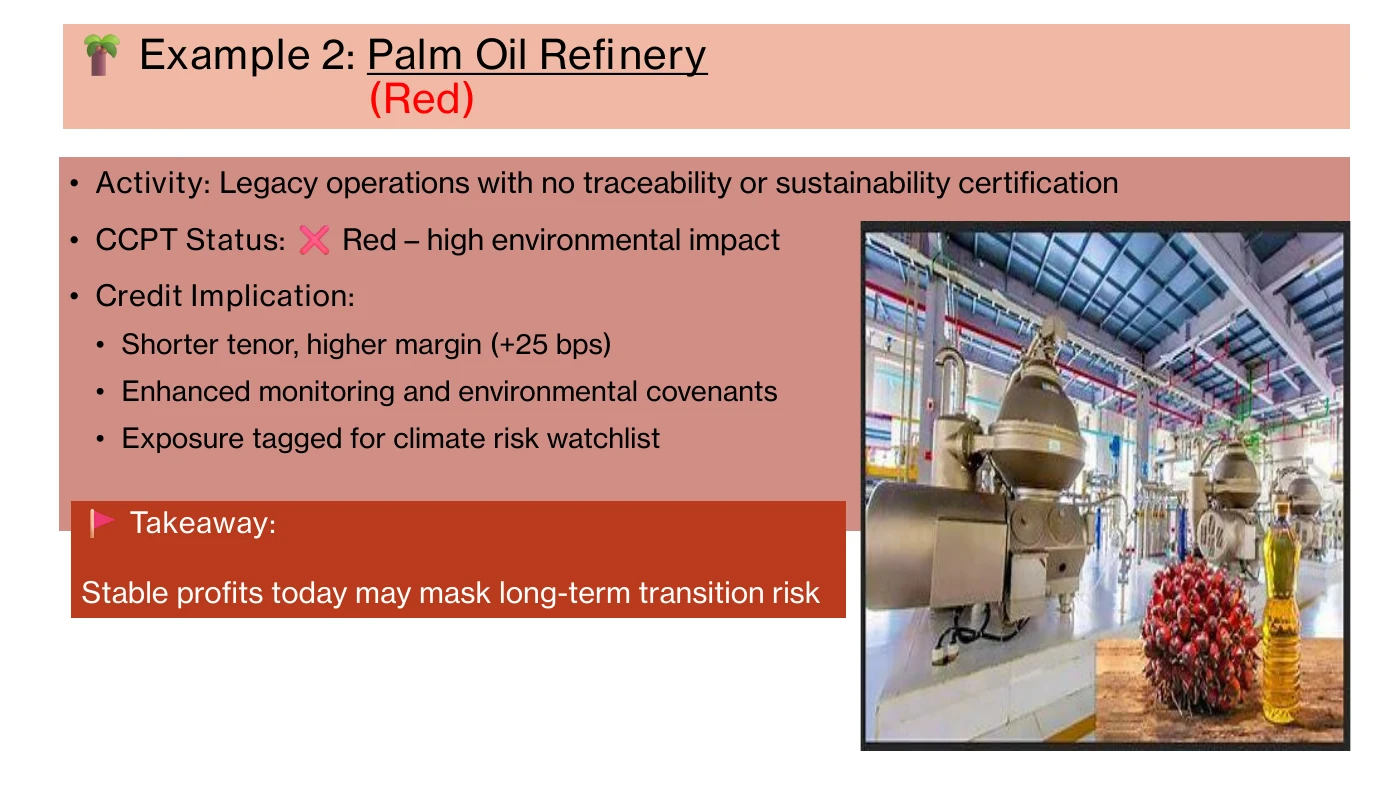
Example 2: Palm Oil Refinery (Red) • Activity: Legacy operations with no traceability or sustainability certification • CCPT Status: Red – high environmental impact • Credit Implication: • Shorter tenor, higher margin (+25 bps) • Enhanced monitoring and environmental covenants • Exposure tagged for climate risk watchlist T akeaway: Stable profits today may mask long-term transition risk

Page 5

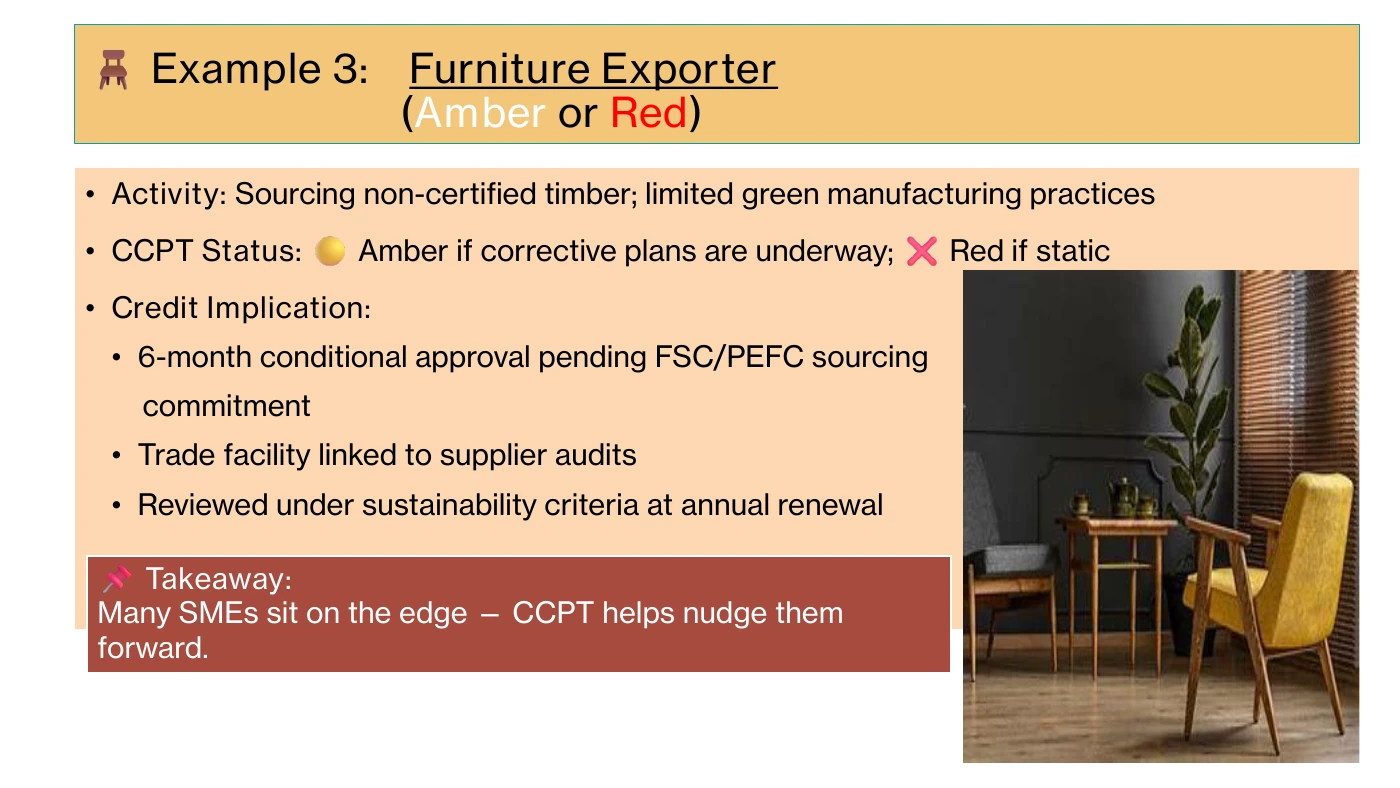
Example 3: Furniture Exporter (Amber or Red) • Activity: Sourcing non-certified timber; limited green manufacturing practices • CCPT Status: Amber if corrective plans are underway; Red if static • Credit Implication: • 6-month conditional approval pending FSC/PEFC sourcing commitment • Trade facility linked to supplier audits • Reviewed under sustainability criteria at annual renewal T akeaway: Many SMEs sit on the edge — CCPT helps nudge them forward.

Page 6

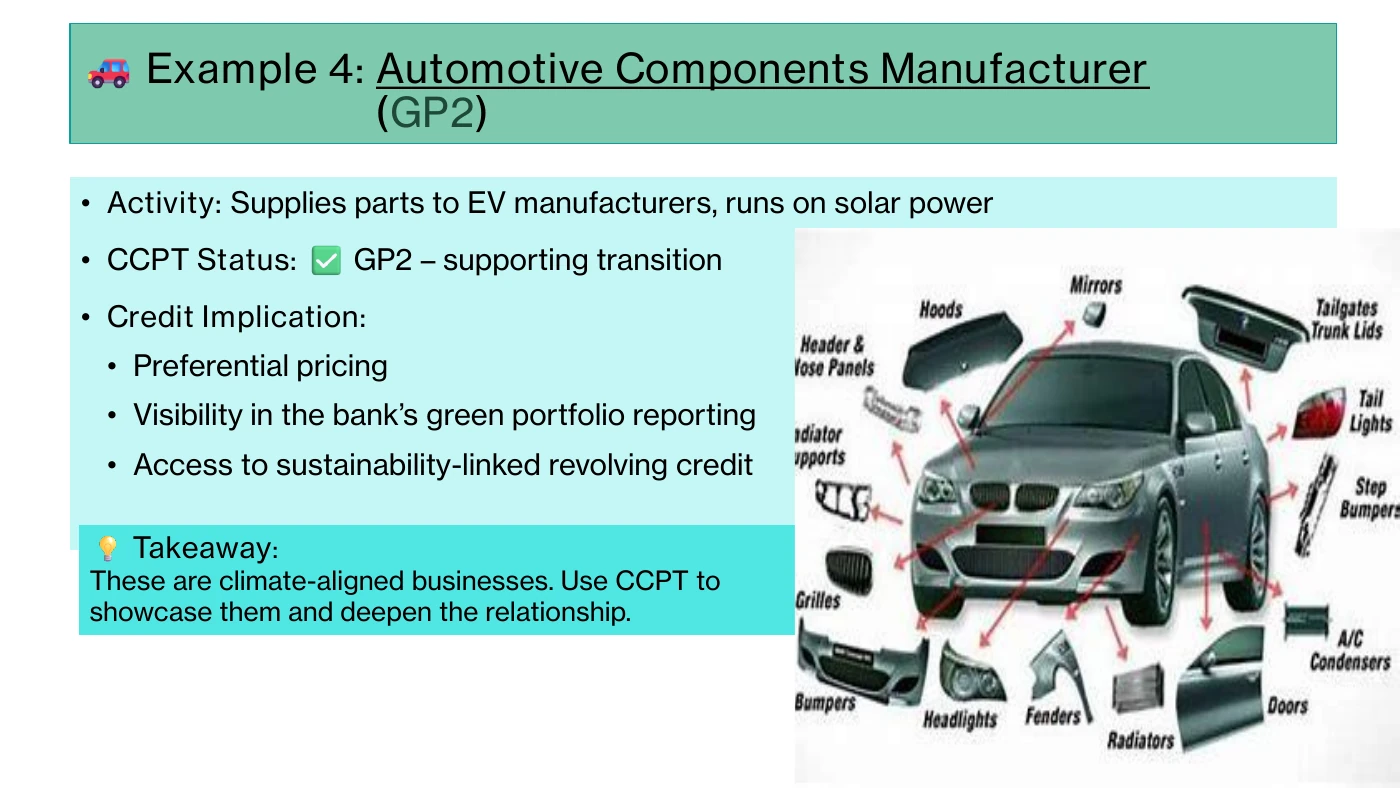
Example 4: Automotive Components Manufacturer (GP2) • Activity: Supplies parts to EV manufacturers, runs on solar power • CCPT Status: GP2 – supporting transition • Credit Implication: • Preferential pricing • Visibility in the bank’s green portfolio reporting • Access to sustainability-linked revolving credit T akeaway: These are climate-aligned businesses. Use CCPT to showcase them and deepen the relationship.

Page 7

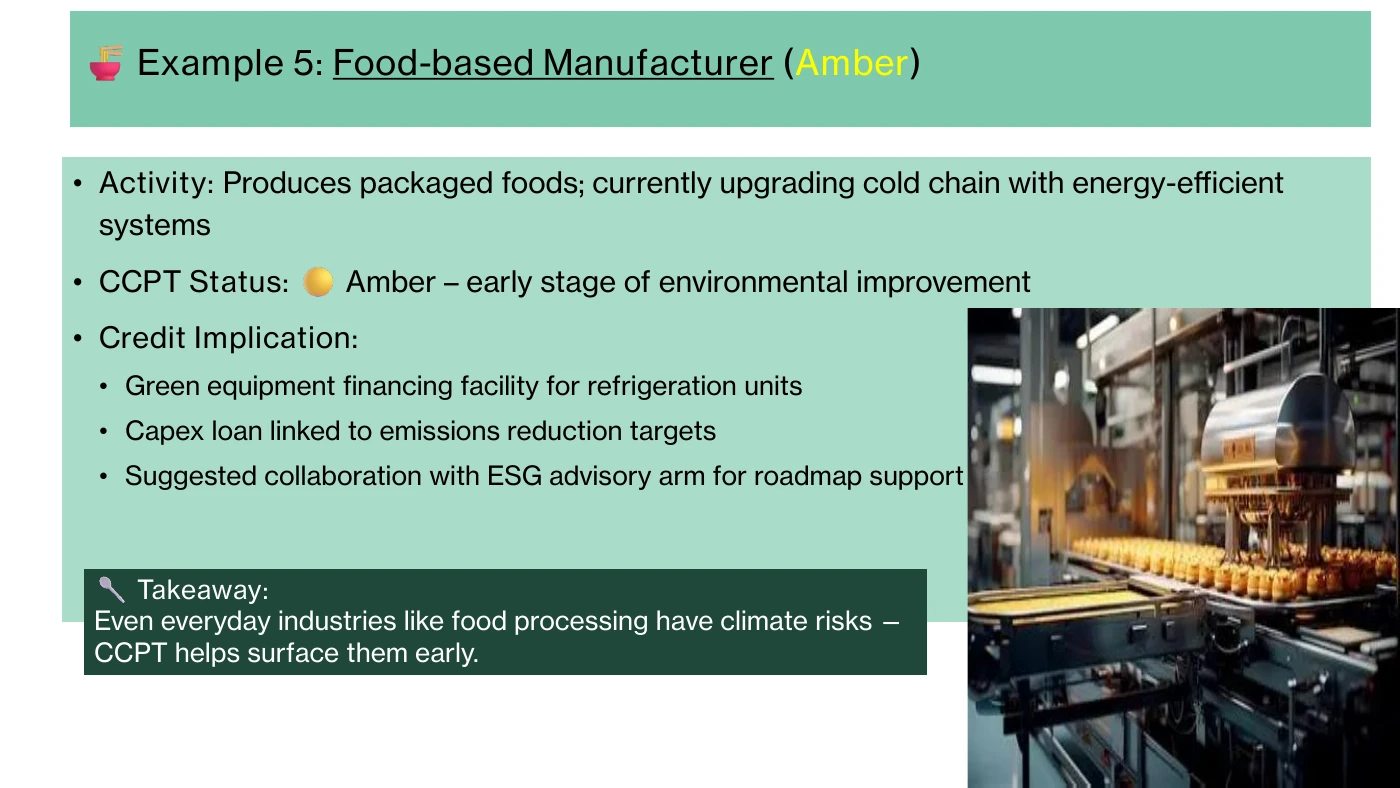
Example 5: Food-based Manufacturer (Amber) • Activity: Produces packaged foods; currently upgrading cold chain with energy-efficient systems • CCPT Status: Amber – early stage of environmental improvement • Credit Implication: • Green equipment financing facility for refrigeration units • Capex loan linked to emissions reduction targets • Suggested collaboration with ESG advisory arm for roadmap support T akeaway: Even everyday industries like food processing have climate risks — CCPT helps surface them early.

Page 8

Example 6: General Goods Trader (Unclassified to Red) • Activity: Imports plastic household goods; no ESG policies or supplier vetting • CCPT Status: Red – passive and misaligned • Credit Implication: • Short-term trade line only; no term facilities approved • Conditions for improvement: sustainable sourcing, packaging reduction • Close monitoring for regulatory or supply chain disruptions T akeaway: Use CCPT to reframe the credit conversation — from “can we finance this?” to “should we?”

Page 9

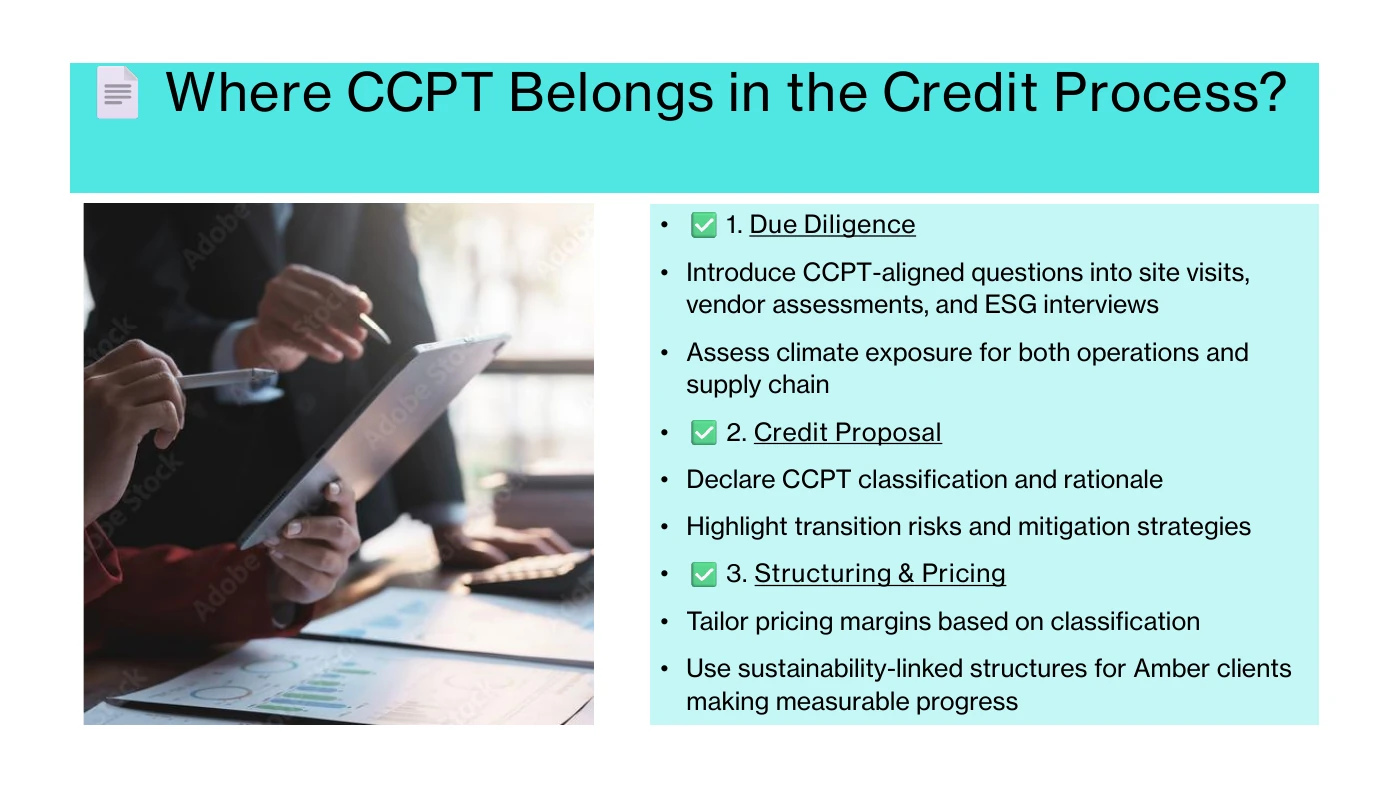
Where CCPT Belongs in the Credit Process? • 1. Due Diligence • Introduce CCPT-aligned questions into site visits, vendor assessments, and ESG interviews • Assess climate exposure for both operations and supply chain • 2. Credit Proposal • Declare CCPT classification and rationale • Highlight transition risks and mitigation strategies • 3. Structuring & Pricing • Tailor pricing margins based on classification • Use sustainability-linked structures for Amber clients making measurable progress

Page 10

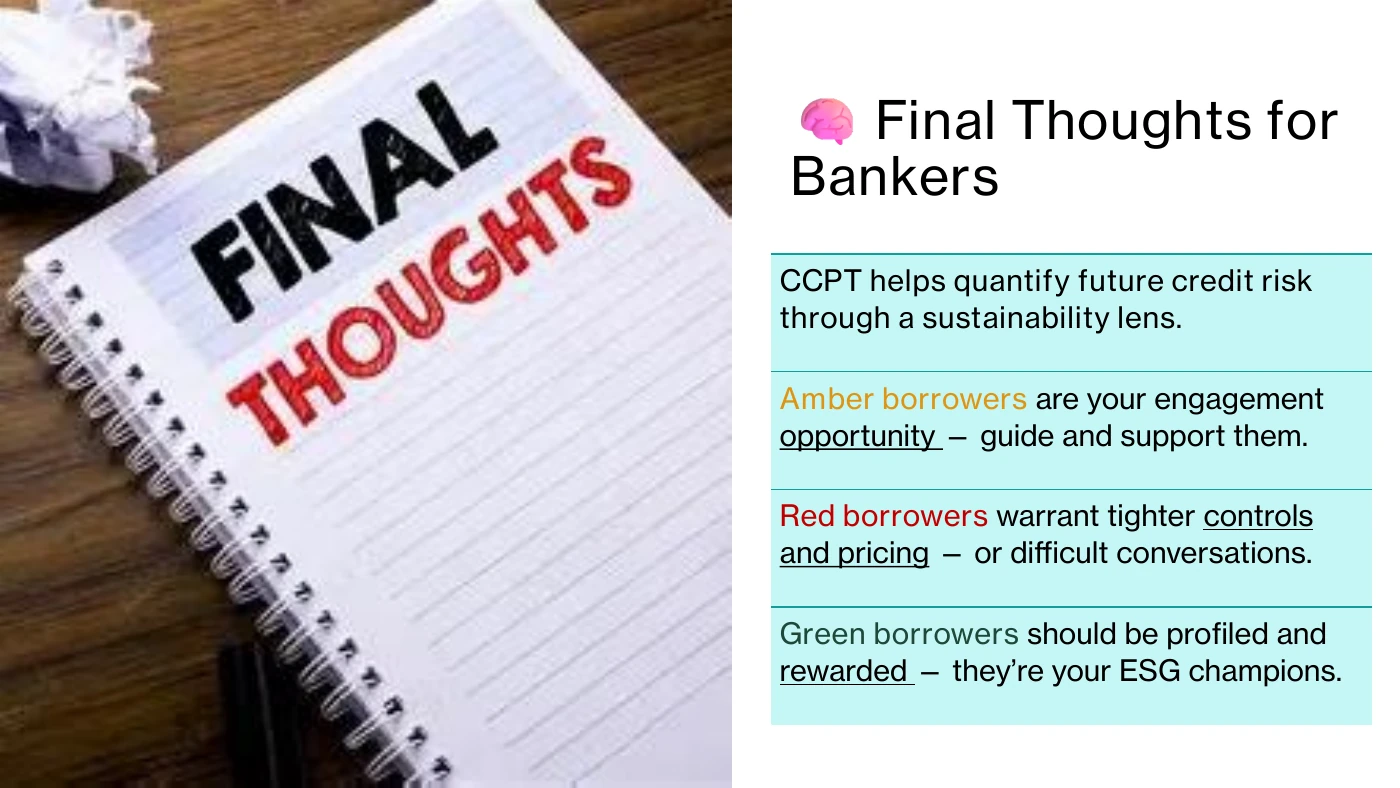
Final Thoughts for Bankers CCPT helps quantify future credit risk through a sustainability lens. Amber borrowers are your engagement opportunity — guide and support them. Red borrowers warrant tighter controls and pricing — or difficult conversations. Green borrowers should be profiled and rewarded — they’re your ESG champions.

Open the complete original PDF

In Yasotha’s words

Original post

From Credit Risk to Climate Risk: Applying CCPT Beyond Compliance

A practical guide for Malaysian bankers

With over 30 years of experience in credit, operational risk, and business continuity — and now ICRP-certified in climate risk — I view under Bank Negara Malaysia’s Climate Change and Principle-based Taxonomy (CCPT), not just as a policy document, but a strategic tool. When used well, CCPT enhances how we assess borrowers, structure facilities, and align risk appetite with long-term sustainability.

But how do we make CCPT work in the real banking world?

Sharing six practical borrower scenarios from Malaysian industries to show how CCPT can be applied by credit and risk practitioners.

👤 From managing complex credit portfolios to embedding operational risk controls and now integrating climate resilience — I’ve seen how a single framework like CCPT can unify bankers around smarter, forward-thinking lending.

In my next article, I’ll explore how Operational Risk and CCPT intersect, including how to embed climate risk into RCSAs, KRIs, and internal controls.

Yasotha K.R Gopal

Banking insight. Practical learning. Thoughtful transition.

LinkedIn

Briefing enquiry

Shape a useful first conversation.

Choose a few starting points, then copy the summary into the channel you prefer. This website prepares a summary; it does not send a message.

Continue on LinkedIn