Read the document text, page by page
Automatically extracted from the original PDF. Reading order and symbols may differ from the designed pages; the PDF remains the authoritative visual version.
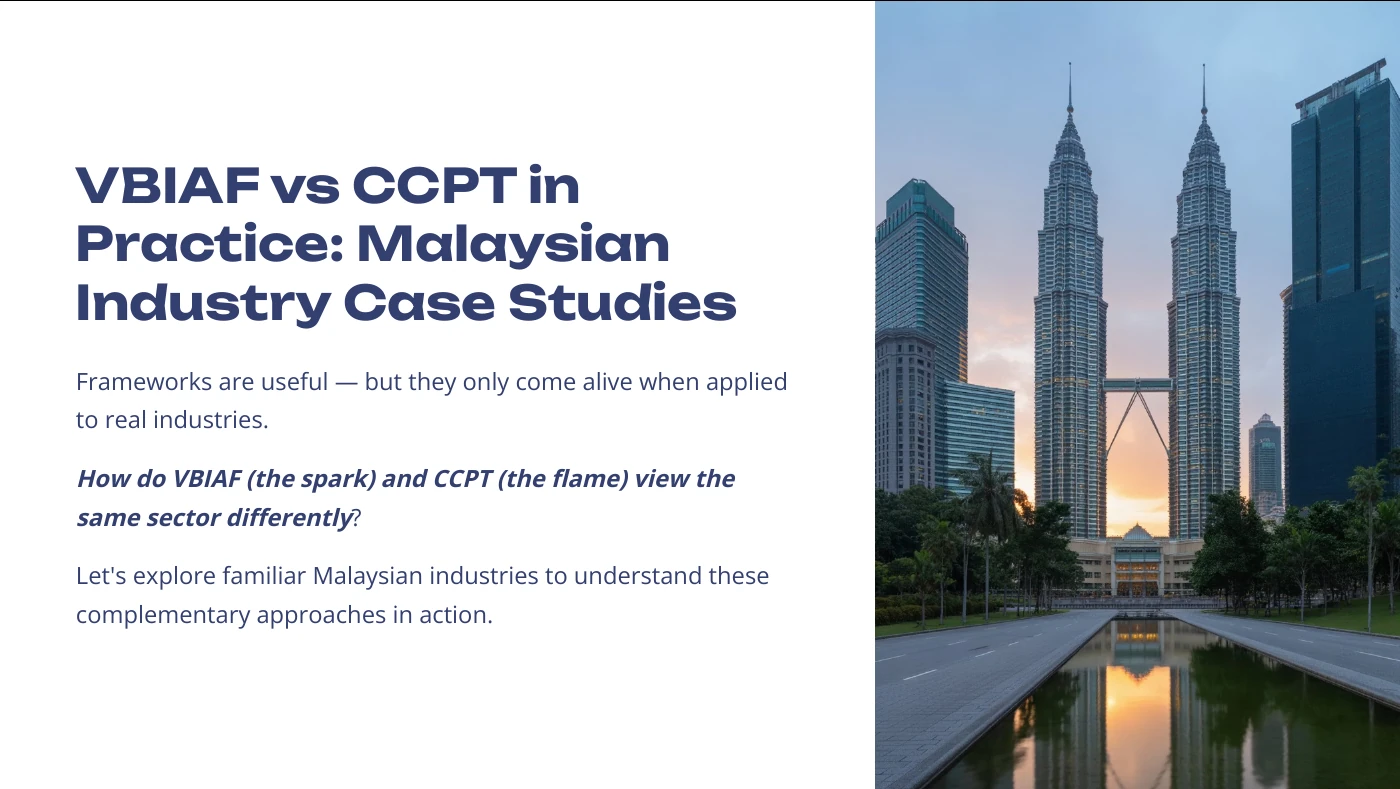
VBIAF vs CCPT in
Practice: Malaysian
Industry Case Studies
Frameworks are useful 4 but they only come alive when applied
to real industries.
How do VBIAF (the spark) and CCPT (the flame) view the
same sector differently?
Let's explore familiar Malaysian industries to understand these
complementary approaches in action.
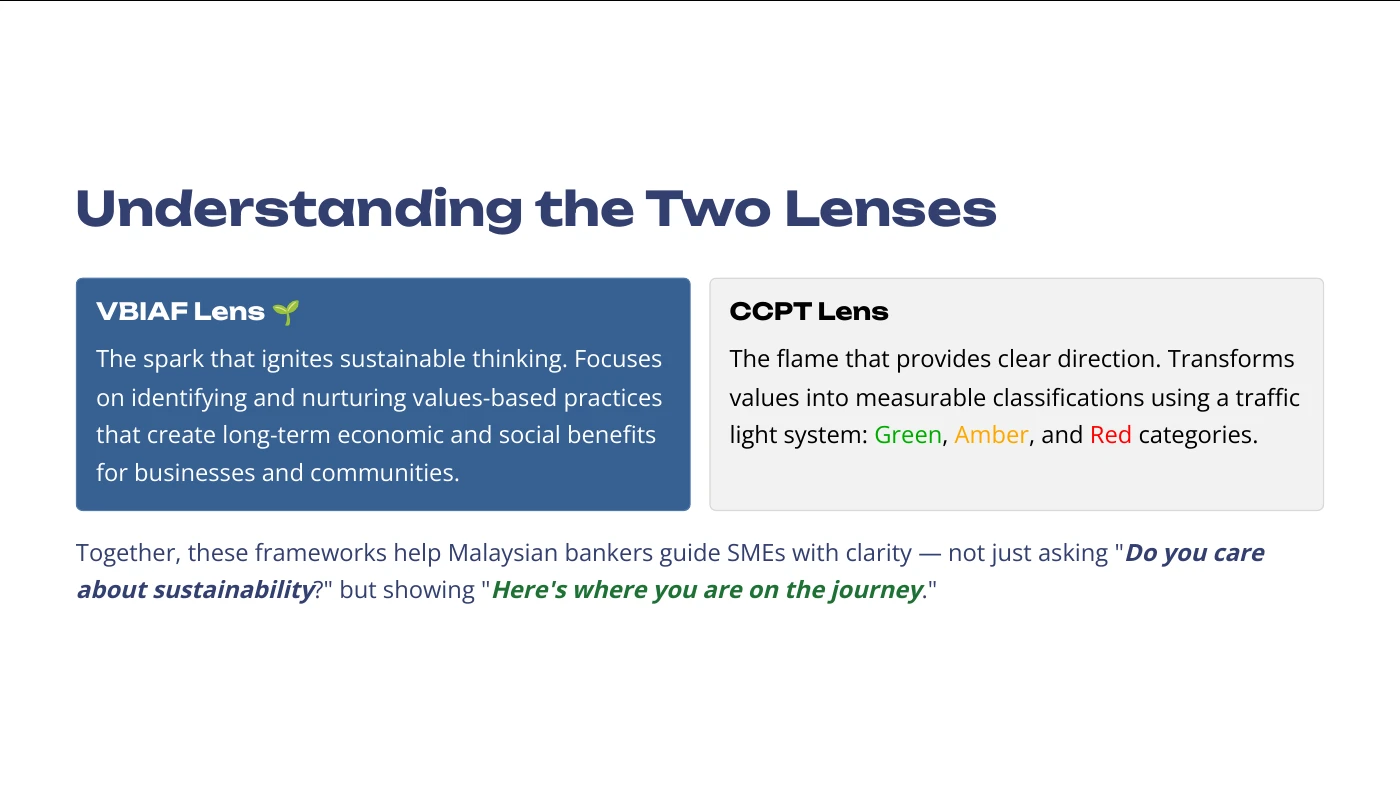
Understanding the Two Lenses
VBIAF Lens /g90
The spark that ignites sustainable thinking. Focuses
on identifying and nurturing values-based practices
that create long-term economic and social benefits
for businesses and communities.
CCPT Lens /g6C6
The flame that provides clear direction. Transforms
values into measurable classifications using a traffic
light system: Green, Amber, and Red categories.
Together, these frameworks help Malaysian bankers guide SMEs with clarity 4 not just asking "Do you care
about sustainability?" but showing "Here's where you are on the journey."
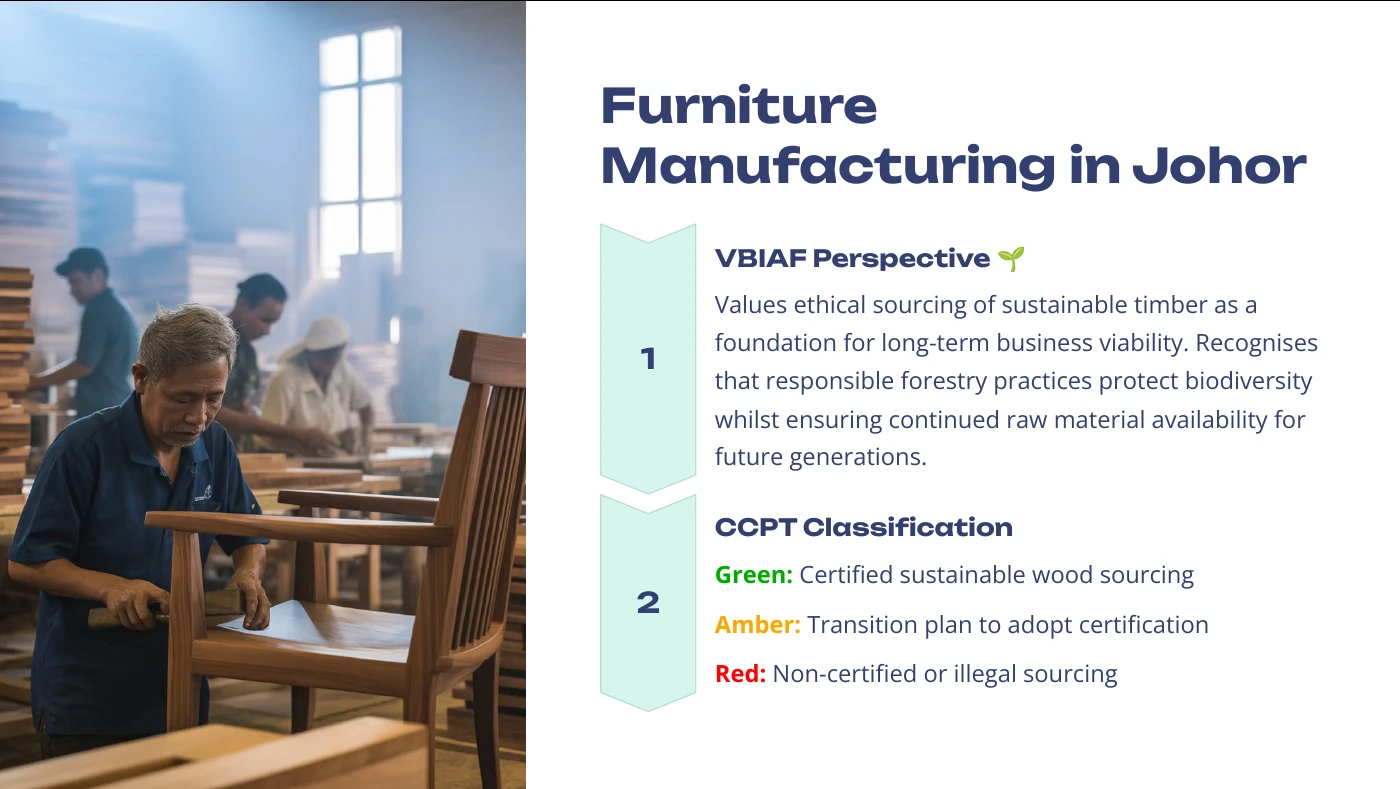
Furniture
Manufacturing in Johor
1
VBIAF Perspective /g90
Values ethical sourcing of sustainable timber as a
foundation for long-term business viability. Recognises
that responsible forestry practices protect biodiversity
whilst ensuring continued raw material availability for
future generations.
2
CCPT Classification /g6C6
Green: Certified sustainable wood sourcing
Amber: Transition plan to adopt certification
Red: Non-certified or illegal sourcing
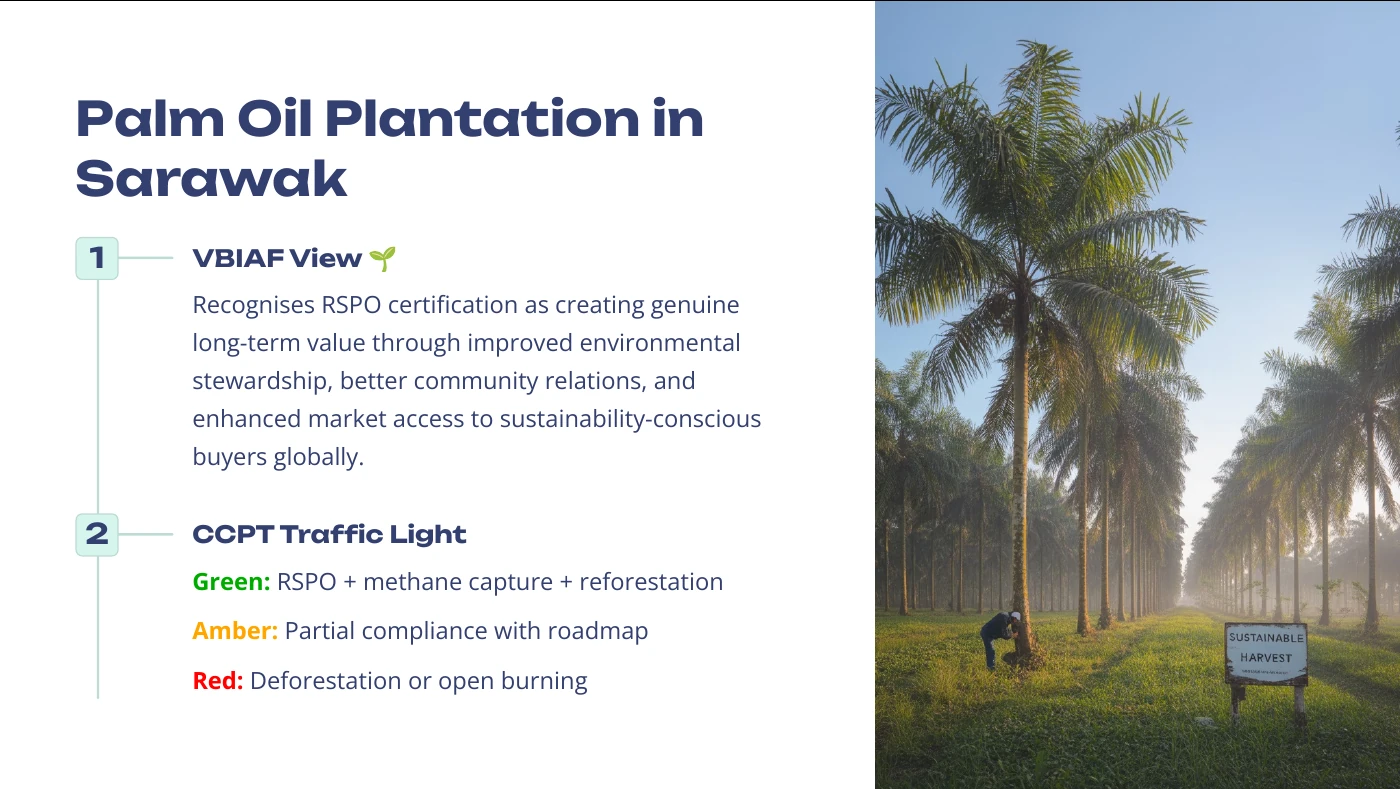
Palm Oil Plantation in
Sarawak
1 VBIAF View /g90
Recognises RSPO certification as creating genuine
long-term value through improved environmental
stewardship, better community relations, and
enhanced market access to sustainability-conscious
buyers globally.
2 CCPT Traffic Light /g6C6
Green: RSPO + methane capture + reforestation
Amber: Partial compliance with roadmap
Red: Deforestation or open burning
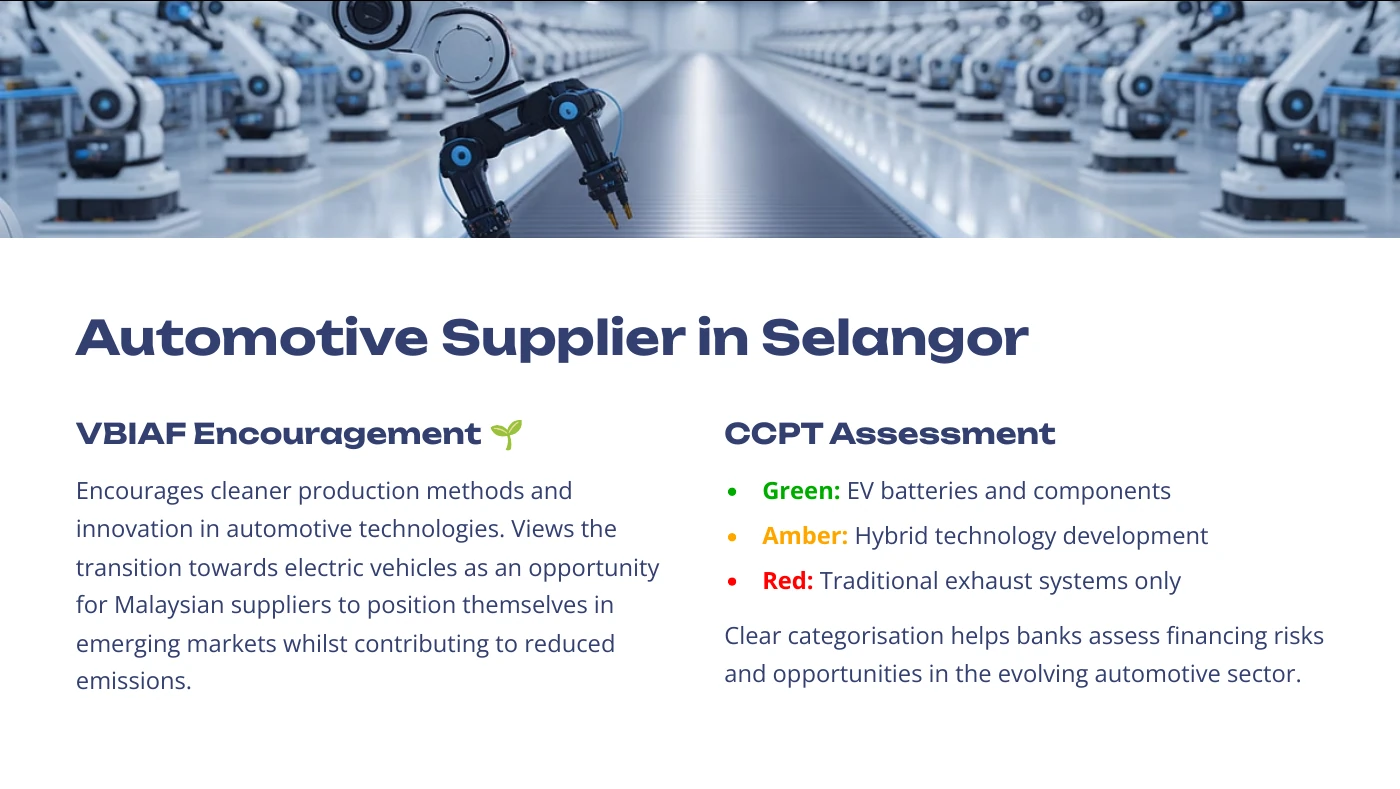
Automotive Supplier in Selangor
VBIAF Encouragement
/g90
Encourages cleaner production methods and
innovation in automotive technologies. Views the
transition towards electric vehicles as an opportunity
for Malaysian suppliers to position themselves in
emerging markets whilst contributing to reduced
emissions.
CCPT Assessment
/g6C6
Green: EV batteries and components
Amber: Hybrid technology development
Red: Traditional exhaust systems only
Clear categorisation helps banks assess financing risks
and opportunities in the evolving automotive sector.
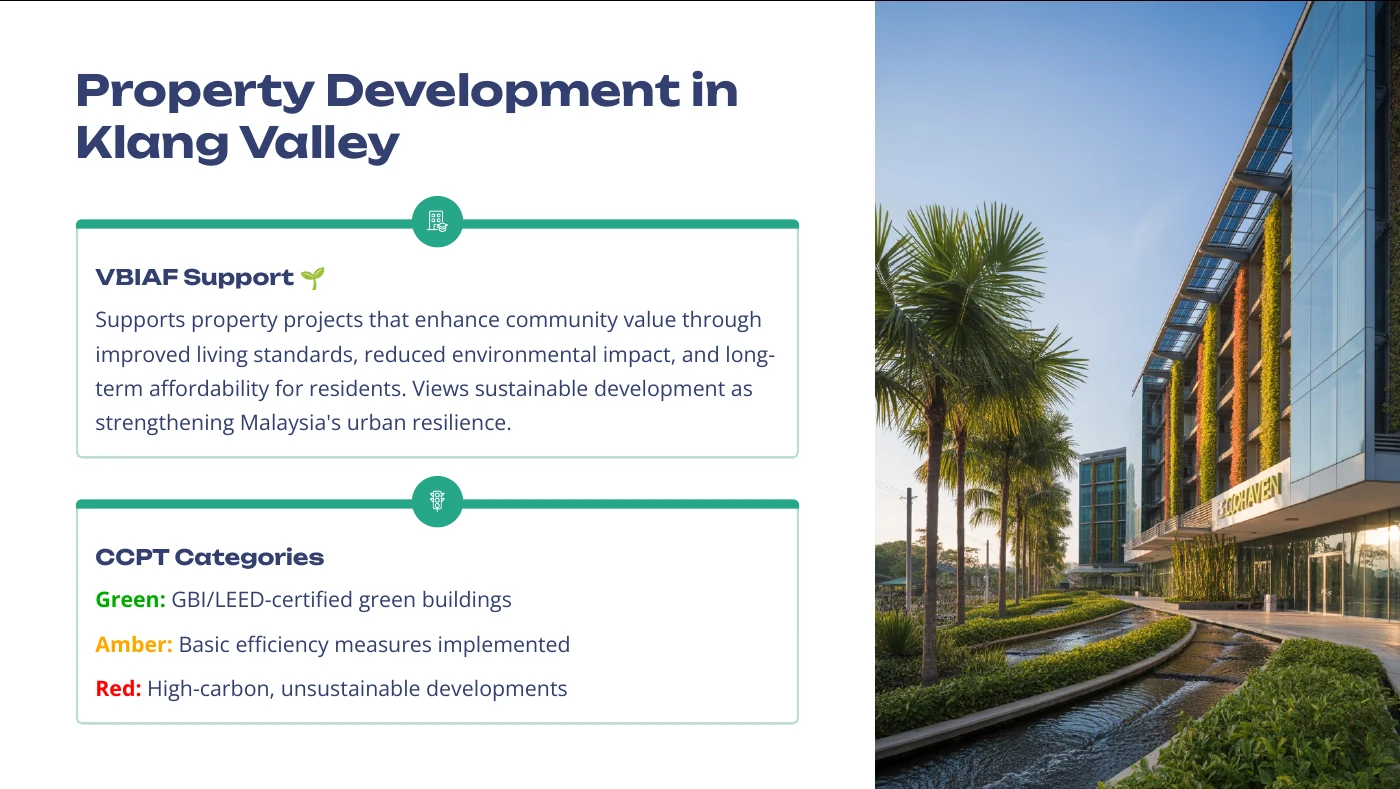
Property Development in
Klang Valley
VBIAF Support /g90
Supports property projects that enhance community value through
improved living standards, reduced environmental impact, and long-
term affordability for residents. Views sustainable development as
strengthening Malaysia's urban resilience.
CCPT Categories /g6C6
Green: GBI/LEED-certified green buildings
Amber: Basic efficiency measures implemented
Red: High-carbon, unsustainable developments
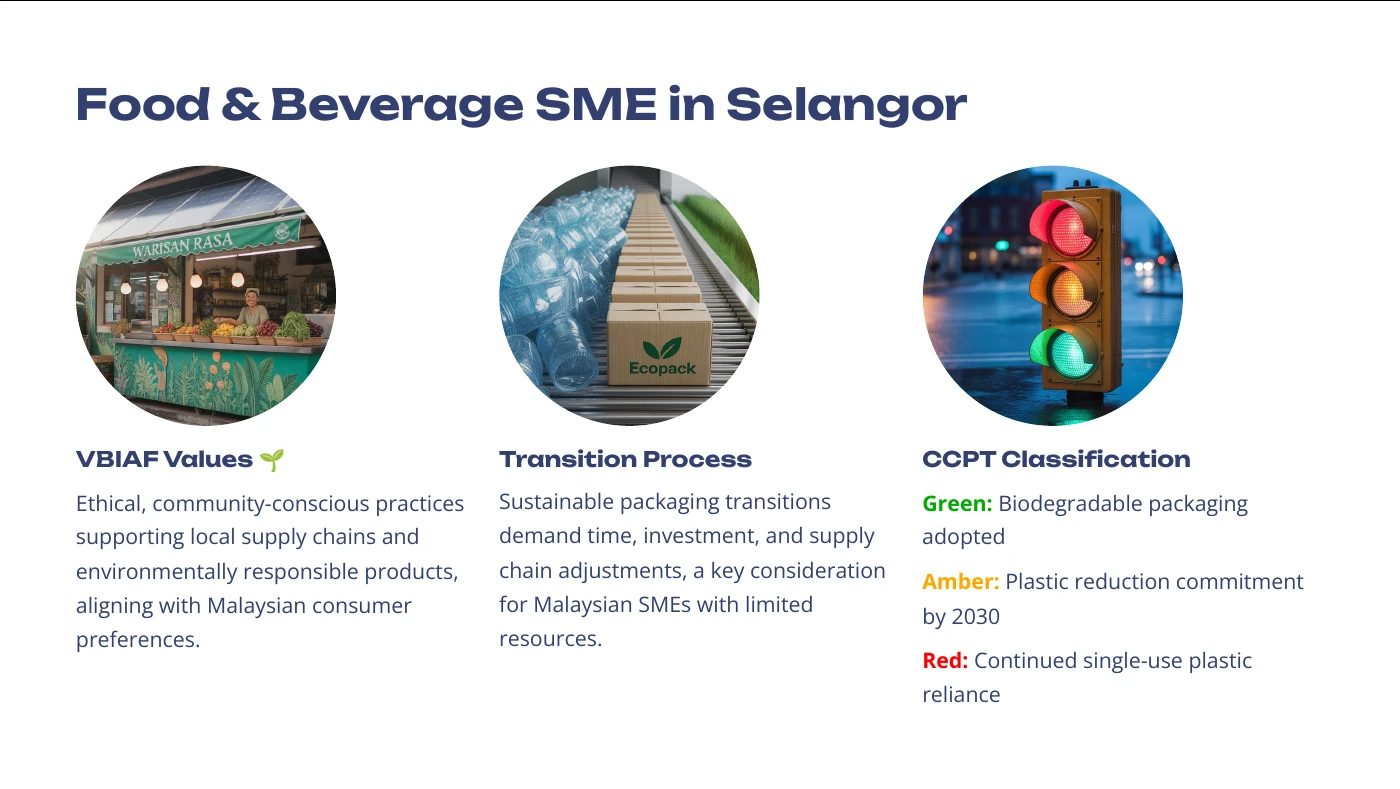
Food & Beverage SME in Selangor
VBIAF Values /g90
Ethical, community-conscious practices
supporting local supply chains and
environmentally responsible products,
aligning with Malaysian consumer
preferences.
Transition Process
Sustainable packaging transitions
demand time, investment, and supply
chain adjustments, a key consideration
for Malaysian SMEs with limited
resources.
CCPT Classification /g6C6
Green: Biodegradable packaging
adopted
Amber: Plastic reduction commitment
by 2030
Red: Continued single-use plastic
reliance
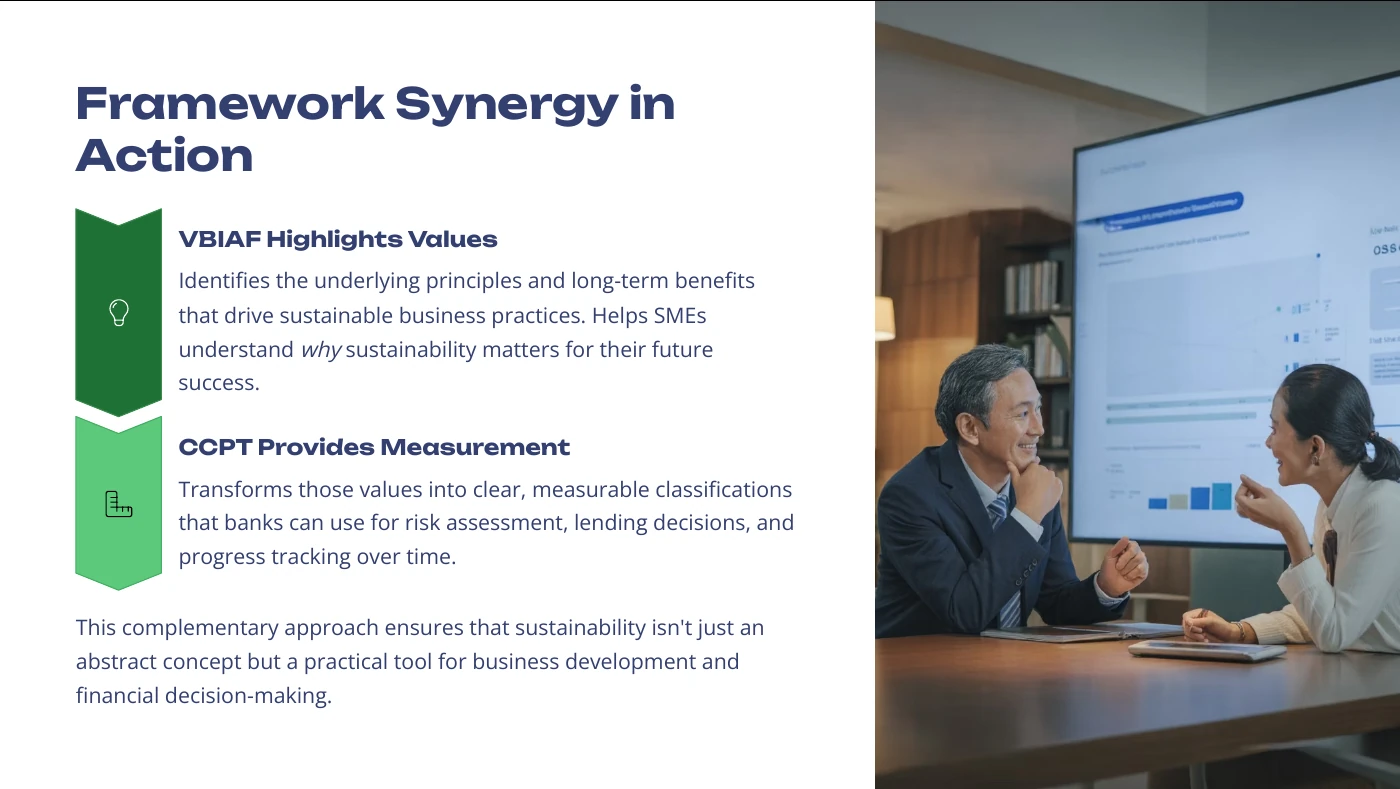
Framework Synergy in
Action
VBIAF Highlights Values
Identifies the underlying principles and long-term benefits
that drive sustainable business practices. Helps SMEs
understand
why sustainability matters for their future
success.
CCPT Provides Measurement
Transforms those values into clear, measurable classifications
that banks can use for risk assessment, lending decisions, and
progress tracking over time.
This complementary approach ensures that sustainability isn't just an
abstract concept but a practical tool for business development and
financial decision-making.
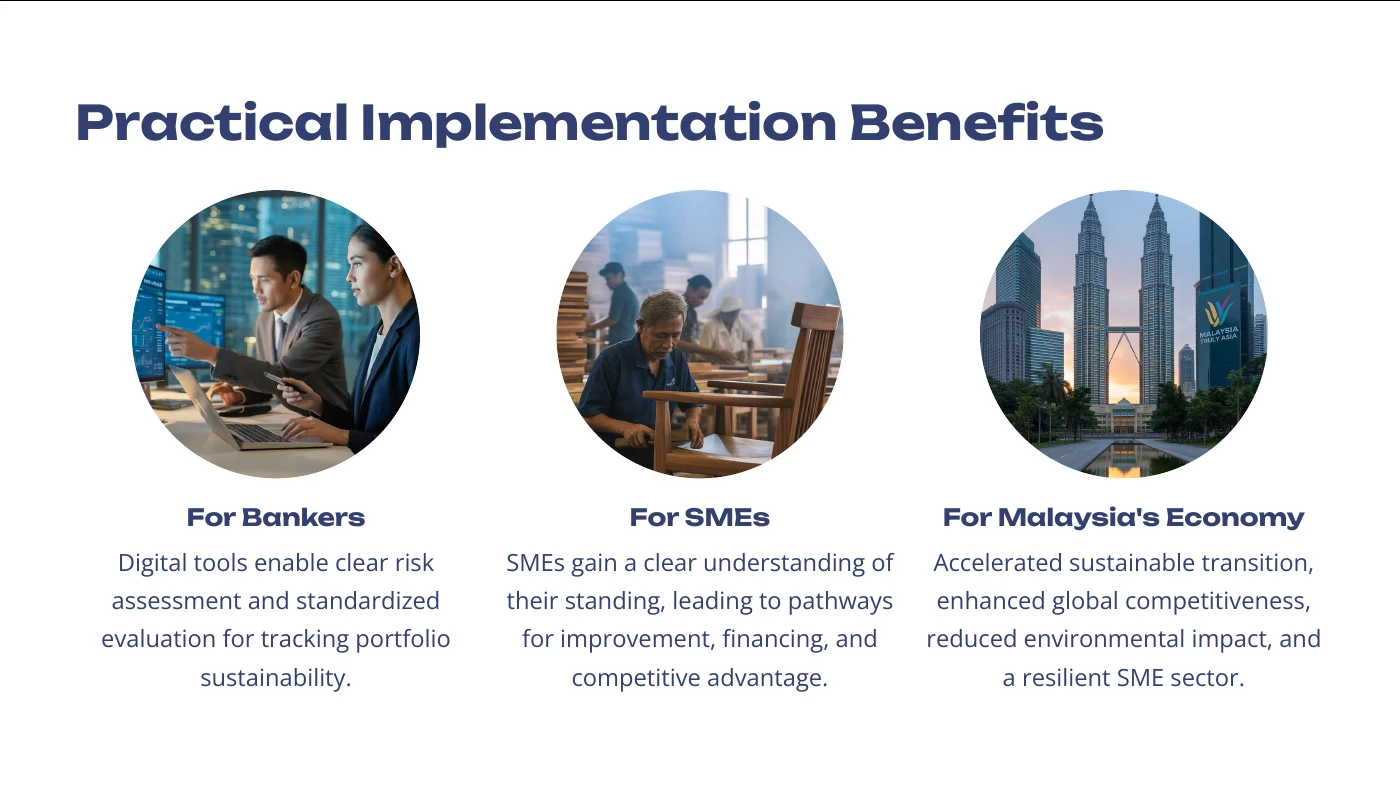
Practical Implementation Benefits
For Bankers
Digital tools enable clear risk
assessment and standardized
evaluation for tracking portfolio
sustainability.
For SMEs
SMEs gain a clear understanding of
their standing, leading to pathways
for improvement, financing, and
competitive advantage.
For Malaysia's Economy
Accelerated sustainable transition,
enhanced global competitiveness,
reduced environmental impact, and
a resilient SME sector.
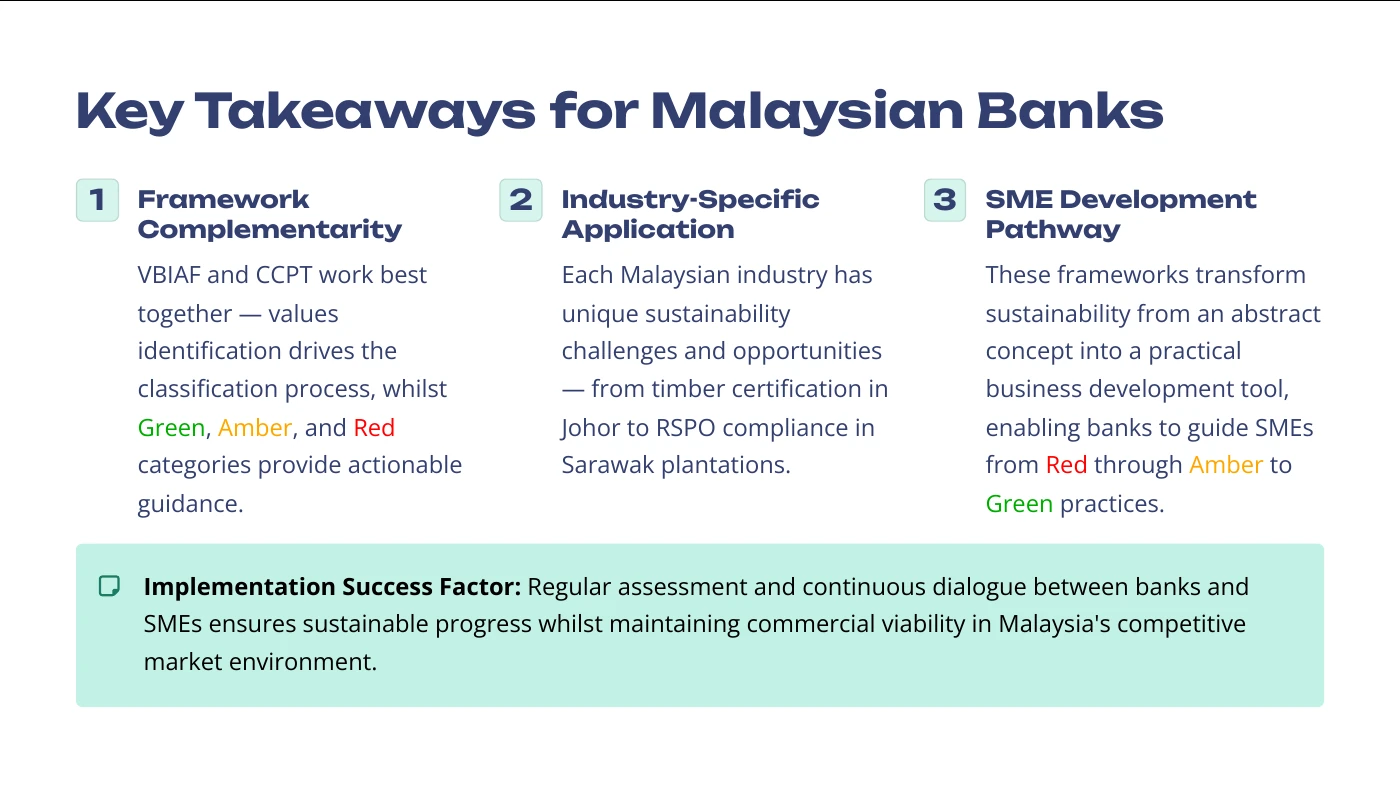
Key Takeaways for Malaysian Banks
1 Framework
Complementarity
VBIAF and CCPT work best
together 4 values
identification drives the
classification process, whilst
Green, Amber, and Red
categories provide actionable
guidance.
2 Industry-Specific
Application
Each Malaysian industry has
unique sustainability
challenges and opportunities
4 from timber certification in
Johor to RSPO compliance in
Sarawak plantations.
3 SME Development
Pathway
These frameworks transform
sustainability from an abstract
concept into a practical
business development tool,
enabling banks to guide SMEs
from
Red through Amber to
Green practices.
Implementation Success Factor: Regular assessment and continuous dialogue between banks and
SMEs ensures sustainable progress whilst maintaining commercial viability in Malaysia's competitive
market environment.