Document & post

How to Explain CCPT to a Relationship Manager

Captured 13 August 2026 · LinkedIn displayed “11mo •” at capture. Original publication date unverified.

Read the original LinkedIn post Jump to original text ↓
Relationship ManagersCCPT & sustainable finance

Original illustrated document

9 pages to explore

Download PDF (770 KB)
Page 1 of How to Explain CCPT to a Relationship Manager. Read the extracted page text below or open the original PDF.

Page 1 of 9

Read the document text, page by page

Automatically extracted from the original PDF. Reading order and symbols may differ from the designed pages; the PDF remains the authoritative visual version.

Page 1

How to Explain CCPT to a Relationship Manager: A Practical Banker’s Guide with Examples

Page 2

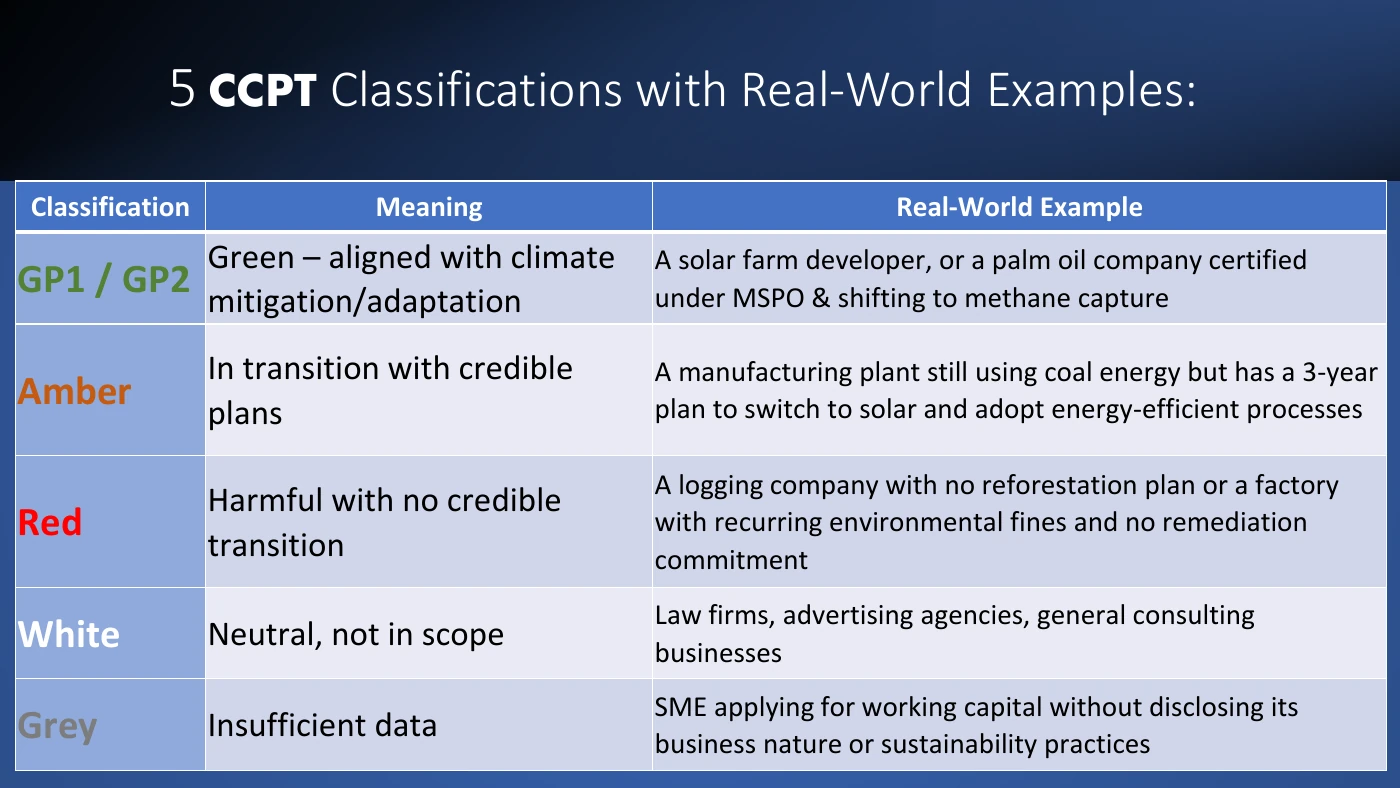
5 CCPT Classifications with Real-World Examples: Classification Meaning Real-World Example GP1 / GP2 Green – aligned with climate mitigation/adaptation A solar farm developer, or a palm oil company certified under MSPO & shifting to methane capture Amber In transition with credible plans A manufacturing plant still using coal energy but has a 3-year plan to switch to solar and adopt energy-efficient processes Red Harmful with no credible transition A logging company with no reforestation plan or a factory with recurring environmental fines and no remediation commitment White Neutral, not in scope Law firms, advertising agencies, general consulting businesses Grey Insufficient data SME applying for working capital without disclosing its business nature or sustainability practices

Page 3

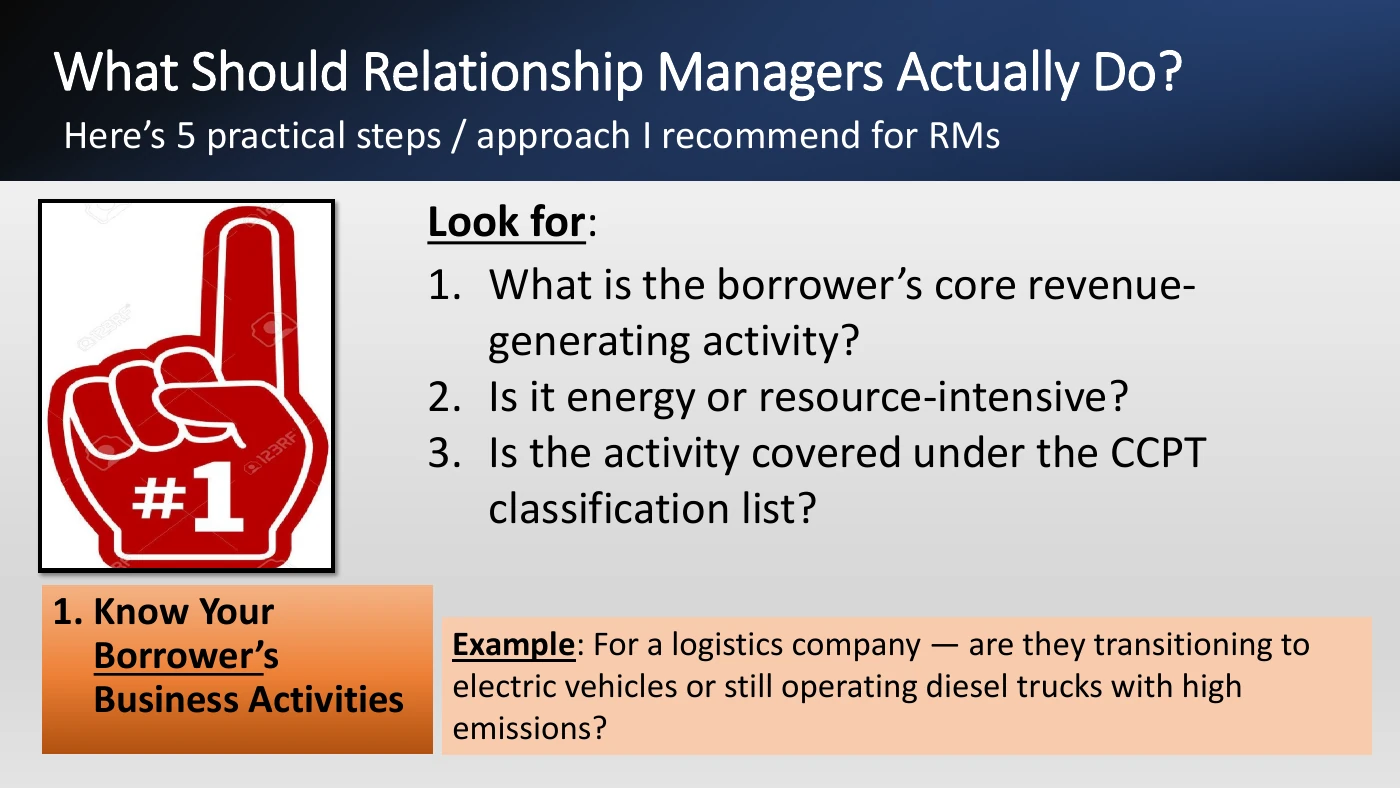
What Should Relationship Managers Actually Do? 1. Know Your Borrower’s Business Activities Look for: 1. What is the borrower’s core revenue- generating activity? 2. Is it energy or resource-intensive? 3. Is the activity covered under the CCPT classification list? Example: For a logistics company — are they transitioning to electric vehicles or still operating diesel trucks with high emissions? Here’s 5 practical steps / approach I recommend for RMs

Page 4

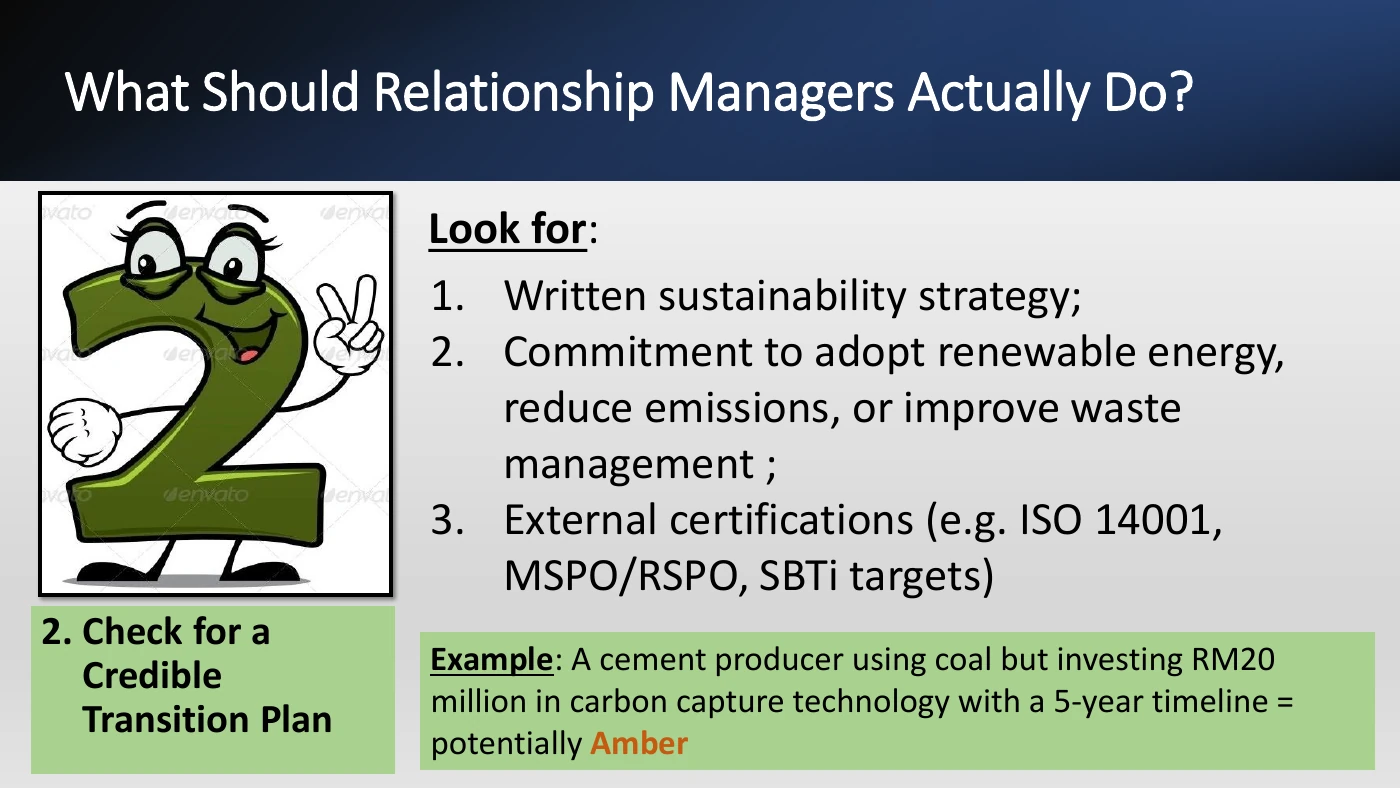
What Should Relationship Managers Actually Do? 2. Check for a Credible Transition Plan Look for: 1. Written sustainability strategy; 2. Commitment to adopt renewable energy, reduce emissions, or improve waste management ; 3. External certifications (e.g. ISO 14001, MSPO/RSPO, SBTi targets) Example: A cement producer using coal but investing RM20 million in carbon capture technology with a 5-year timeline = potentially Amber

Page 5

What Should Relationship Managers Actually Do? 3. Work with ESG/Credit Risk/SME (subject matter expert) Units Most RMs are not expected to classify on their own. Banks usually have internal ESG tools or CCPT classification guides. BUT RMs must initiate the conversation and ask relevant questions Example: Forwarding the borrower’s sustainability report or environmental audit to Risk/ESG teams for assessment

Page 6

What Should Relationship Managers Actually Do? 4. Document the Assessment Clearly Ensure the credit paper/memo includes: 1. The CCPT classification (e.g. Amber – transitioning with clear plan) 2. Key justifications (e.g. MSPO certification, RM5m solar investment, etc disclosed by customer) 3. Gaps or red flags (RM’s observation is key) Example: “The borrower is classified as Amber due to its commitment to shift 50% of its fleet to EVs by 2026. Plan submitted and supported by board resolution.”

Page 7

What Should Relationship Managers Actually Do? 5. Monitor & Review Especially important for Amber exposures, where the business is in transition Post-disbursement actions: 1. Track KPIs like energy efficiency upgrades, emissions reduction, or ESG audits 2. Request progress reports annually or semi-annually 3. Reassess CCPT classification as the client improves (or regresses) Example – Palm Oil SME (Red) Client fails to adopt NDPE policy after 12 months. ➢ Bank may suspend further disbursement or reprice the facility.

Page 8

Why CCPT Matters More Than Ever? A well-informed RM can help shape better deals, faster approval, and more resilient portfolios. Since July 2022, all financial institutions in Malaysia must report their exposures by CCPT categories. Over time, this data feeds into: 1. Internal risk models and stress testing 2. Pricing decisions (e.g. +25bps for Red, –10bps for Green) 3. Regulatory capital planning 4. ESG disclosures aligned to IFRS S2/TCFD

Page 9

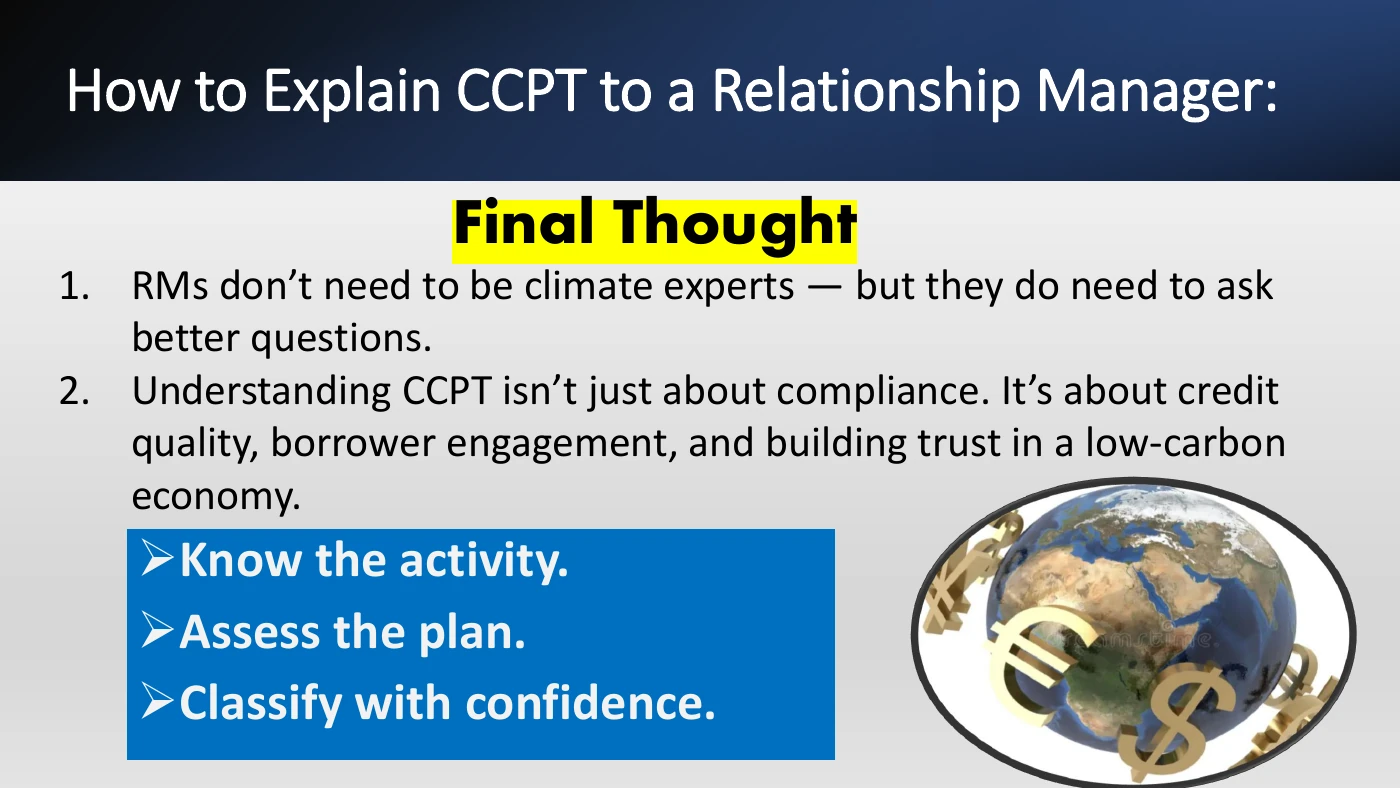
How to Explain CCPT to a Relationship Manager: ➢Know the activity. ➢Assess the plan. ➢Classify with confidence. Final Thought 1. RMs don’t need to be climate experts — but they do need to ask better questions. 2. Understanding CCPT isn’t just about compliance. It’s about credit quality, borrower engagement, and building trust in a low-carbon economy.

Open the complete original PDF

In Yasotha’s words

Original post

How to Explain CCPT to a Relationship Manager/Credit Officers: A Practical Banker’s Guide.

“What’s CCPT and why does it matter to me?”

That’s the question I often hear from Relationship Managers (RMs) across business units. And it’s a fair one.

As frontliners, RMs are expected to meet business targets, build strong client relationships, and now — understand climate-related risks too. But Bank Negara Malaysia’s Climate Change and Principle-based Taxonomy (CCPT) doesn’t have to be overwhelming. Think of it as a practical lens to assess future creditworthiness.

- What is CCPT in Simple Terms?

CCPT is a classification tool introduced by BNM to help financial institutions understand whether an activity is:

a. Supporting the climate transition (Green), or b. Trying to get there (Amber), OR c. Contributing to environmental harm (Red).

It looks at two things: 1. The economic activity of the borrower, and 2. Whether that activity has a credible transition plan.

I have shared below a practical approach recommended for Relationship Manager/Credit Officers and hope it helps.

Not stopping there; do also look out for my next sharing - How CCPT Influences Lending, Pricing, and Risk Decisions
Yasotha K.R Gopal

Banking insight. Practical learning. Thoughtful transition.

LinkedIn

Briefing enquiry

Shape a useful first conversation.

Choose a few starting points, then copy the summary into the channel you prefer. This website prepares a summary; it does not send a message.

Continue on LinkedIn